Storm season is a brutal audit. Water and wind do not care that you meant to check the guttering next weekend. They simply find the loose joint, the blocked outlet, and the one section you kept pretending was “probably fine.”
If you are here, you are probably asking the sensible questions. What should you inspect before heavy rain starts? Which roofline issues are minor and which ones are a warning shot? What can you safely deal with yourself, and when does “DIY confidence” become an expensive false lead?
The short answer is that roofline problems usually advertise themselves early if you bother to look. The National Weather Service treats severe thunderstorms as a recurring hazard because heavy rain, damaging wind, and sudden runoff are normal parts of the package, not rare drama. The same agency’s flood safety guidance is a useful reminder that water damage often starts with the boring route: bad drainage, overflow, and water going somewhere it should not.
This checklist is built for that boring route. You will learn what to inspect on the gutter line, how to clear obvious debris without turning the job into a stunt, what to check around downpipes and drainage paths, which symptoms mean a repair is already due, and when it is smarter to call for help before the next storm does the decision-making for you.
Terminology, so the checklist is not speaking in code
Roofline conversations become muddled fast when every component gets called “the gutter bit.” That is how people end up replacing the wrong part or describing the right problem badly.
- Gutter: the horizontal channel that collects rainwater at the roof edge.
- Fascia: the vertical board behind the gutter where brackets are often fixed.
- Soffit: the underside section below the fascia, usually visible when you stand near the wall and look up.
- Downpipe: the vertical pipe carrying water from the gutter to ground drainage.
- Joint or union: the connector where two gutter sections meet.
- Outlet: the point where water leaves the gutter and enters the downpipe.
That vocabulary matters because the symptom and the failed part are not always the same thing. Water staining on the fascia might be caused by a blocked outlet. Dripping at a joint might be driven by a sagging run two brackets away. If you can name the parts clearly, you are less likely to chase the wrong fix.
Quick roofline checklist before storm season
Do the first pass from ground level in good light. This is not the moment to improvise a heroic climb. You are looking for symptoms, not trying to win points for enthusiasm.
| Area to check | What to look for | Why it matters in a storm |
|---|---|---|
| Gutters | Sagging runs, visible debris, staining, standing water marks | Overflow starts here when water cannot move fast enough |
| Fascia boards | Peeling, swelling, staining, soft spots, open gaps | Repeated leaks can push moisture behind the roofline |
| Downpipes | Loose clips, cracks, blocked openings, poor discharge at the base | A clear gutter still fails if the downpipe cannot carry water away |
| Joints and corners | Separated sections, dark streaks, drips, slipped connectors | Storm water exploits weak connections quickly |
Gutters
Check the boring thing first: is the gutter line straight enough to drain, and can you see signs that water has been escaping? Leaves, moss, and roof grit are the usual suspects, but the actual problem is often a gutter holding water because the fall is wrong or a bracket has loosened.
- Look for dips or sagging. A gutter that bows in the middle is collecting weight, not managing it.
- Look for dark streaks on the wall below. Water tends to leave a confession.
- Look for debris at outlets. One clogged opening can back up an entire run.
Fascia boards
Fascia boards sit behind the gutter and quietly take the blame when water has been misbehaving for months. If the paint is failing, the board looks swollen, or the surface has gone soft, do not write that off as cosmetic. Storm season is very good at converting “only cosmetic” into repair work.
- Watch for staining or bubbling paint. That often points to repeat wetting.
- Check for movement around fixings. Fasteners should not look as though they are slowly giving up.
- Notice any visible gaps between fascia and gutter brackets. Movement there usually gets worse under heavy water load.
Downpipes
People blame gutters because they are easier to see. Downpipes are often the actual problem. If the top entry is blocked or the base discharges into a clogged gully, the system backs up and starts performing water features nobody asked for.
- Check that the downpipe is still tight to the wall. Loose clips let joints strain and split.
- Look into the top if it is visible from a safe position. Leaves and nests can block the entry point.
- Inspect the base. Water should have a clear route away from the building, not a short career as a puddle.
Joints and corners
Corners and joints are where small failures become repeat failures. If a connector has shifted, a seal has perished, or two lengths no longer meet cleanly, the storm will notice even if you did not.
- Check for visible gaps. Tiny separations are enough to cause a steady leak.
- Check beneath corners for staining. Corner leaks are common and easy to miss from a distance.
- Check for sections that look twisted. Movement at one bracket can distort the joint beside it.
Clear debris safely, without turning maintenance into theatre
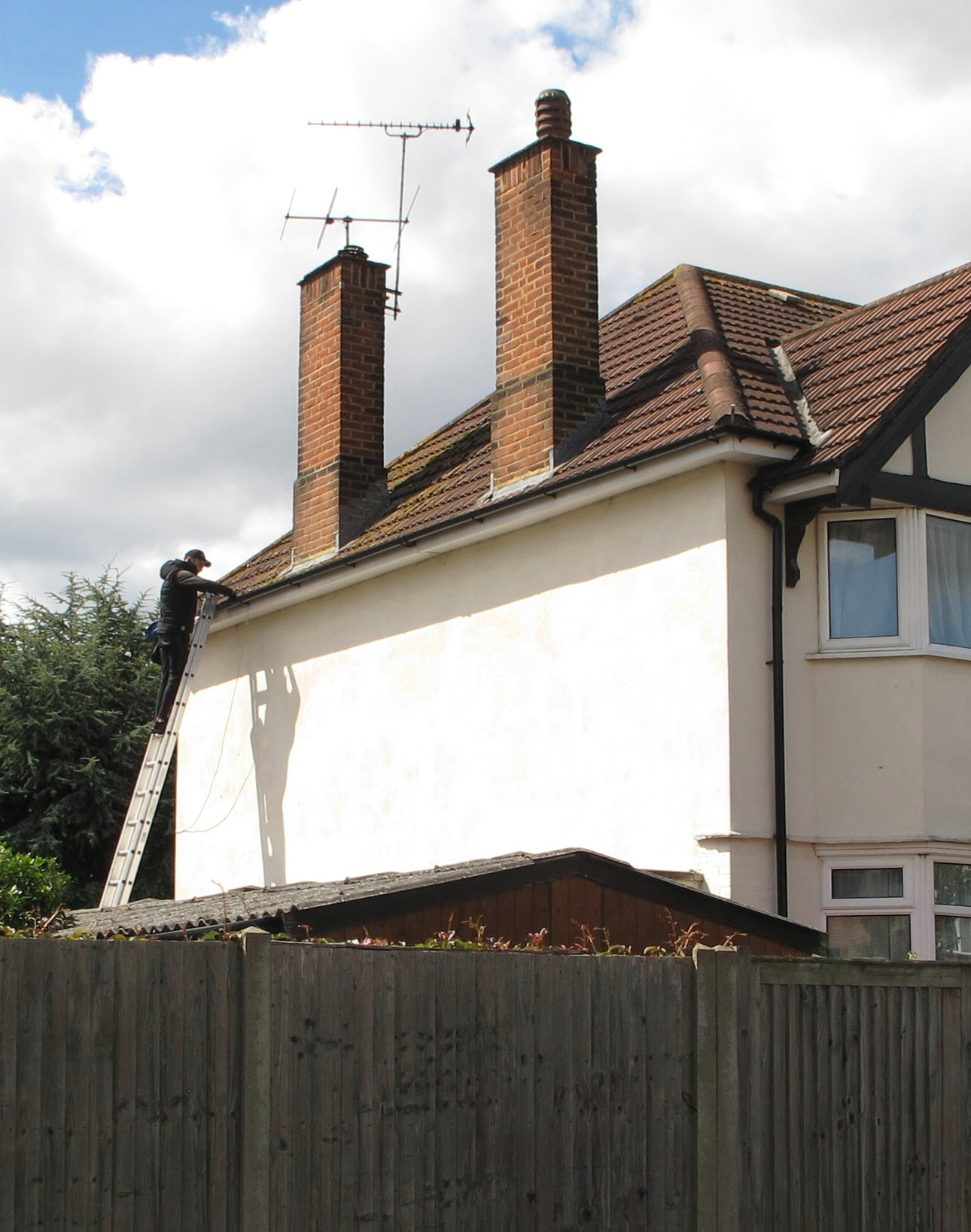
If debris is clearly present and you can deal with it safely, do that before storm season starts. If safe access is doubtful, stop there. The OSHA ladder safety guidance exists for a reason: ladders and rushed judgment are an ugly combination.
The rule is simple: if access feels unstable, awkward, high, or obstructed, call someone with the right equipment. Water damage is expensive. Falling off a ladder is worse.
If you can work safely at a low, manageable section, keep the job basic:
- Wear gloves and use a small scoop or hand brush. You are removing debris, not excavating a ruin.
- Use a bucket or bag for waste. Dumping wet gutter sludge onto paving just creates the next blockage below.
- Clear outlets gently. Forcing compacted debris down a downpipe is a clever way to hide the blockage where you can no longer reach it.
- Stop if the gutter moves. A loose section needs repair, not extra leverage.
What not to do: do not lean too far, do not stretch sideways to “finish the last bit,” and do not keep going because you are already halfway through. Those are not plans. They are the opening lines of a bad idea.
Check drainage paths around downpipes
A cleaned gutter is not the same thing as a working drainage system. You still need to know where the water goes when it leaves the downpipe.
The Environmental Protection Agency’s guidance on disconnecting or redirecting downspouts and broader runoff management is useful here because it focuses on the practical part people skip: discharge needs a clear path, and water sitting at the base of the building is not “drained,” it is delayed.
Walk the downpipe route and check:
- Gullies and drains. Clear visible silt, leaves, and mud from the opening area.
- Splash zones. Look for soil erosion, standing water, or repeated pooling near the wall.
- Paving falls. Hard surfaces should not pitch water back toward the property.
- Extension pieces or shoes. If the outlet kicks water straight onto the base of the wall, that is not a finished drainage plan.
A quick symptom guide helps:
- Water stains low on the wall: likely repeat splashback or poor discharge.
- One downpipe area always soggy: likely blockage or runoff collecting at the base.
- Overflow at the gutter during heavy rain only: possibly limited outlet capacity, partial blockage, or poor fall.
- Overflow in light rain too: more likely a structural issue such as misalignment, a major blockage, or failed joints.
If the ground-level drainage is a mess, the roofline cannot perform properly no matter how clean the visible gutter section looks. Water follows the full route. It does not stop at the part you inspected.
Common false leads that waste time before storms
Storm prep goes wrong when people fix the most visible symptom rather than the actual failure path. Here are the usual false leads worth ruling out.
“It only overflows in very heavy rain, so that is normal”
Some extreme weather will stress any drainage system, but repeat overflow at the same spot is not a personality trait. It usually points to limited outlet flow, poor fall, joint failure, or a drainage path that cannot cope with the water volume.
“The gutter is clean, so the system is fine”
A clean visible run can still fail because the downpipe is blocked lower down, the shoe discharges badly, the gully below is choked, or the brackets no longer hold the right line. Clean and functional are related, not identical.
“It is just cosmetic staining”
Sometimes yes. Often no. Staining is evidence of where water has been. Even if the finish damage is superficial today, it can still be pointing to a leak path that gets worse when wind and rainfall increase.
“I will deal with it after the first storm and see what happens”
That is one way to gather data, but it is an expensive research method. Storm season is better used to test a prepared system, not a neglected one. If you already have clear symptoms now, the first storm usually adds damage rather than clarity.
Look for early warning signs before they become repair invoices
Most roofline failures do not arrive out of nowhere. They mutter first. Then they leak. Then they make you spend money.
Rule these out before storm season:
- Loose sections. If a gutter or downpipe moves when touched, storm load will move it more.
- Gaps in joints. Even a narrow opening can produce a persistent leak under rainfall.
- Visible corrosion, cracking, or brittleness. Old materials rarely become more flexible under pressure.
- Recurring stains. If the same mark keeps returning after cleaning, the leak was never truly solved.
- Vegetation growing from the roofline. Congratulations, your gutter has become a planter. It is not supposed to do that.
Also pay attention to symptoms inside the property near the roof edge. Damp patches near upper corners, peeling finishes, or musty spots after heavy rain can mean the roofline problem has already graduated beyond an external nuisance.
When to call a professional before the next storm
Call a professional if the issue involves height, unstable access, persistent leaks, or visible movement in the system. That is not caution for its own sake. It is triage.
Professional help is usually the right next step if:
- the gutter line is loose, sagging, or pulling away from the fascia,
- joints are leaking in multiple places,
- downpipes seem blocked below the visible opening,
- you can see staining or deterioration on fascia or soffits,
- access involves significant height, awkward roof shapes, conservatories, or fragile surfaces,
- overflow keeps returning after basic cleaning.
If that is where you are, the sensible next move is to contact RC Grant & Sons and describe the symptom, the location, and when it happens. Clear details save time. “Rear corner over conservatory, overflows in heavy rain, staining below the joint” is useful. “Something up there looks off” is honest, but less efficient.
When choosing any contractor, ask plain questions:
- What do you think the actual problem is?
- Are you recommending cleaning, repair, or replacement, and why?
- What access method will you need?
- Are the fascia, soffit, and gutter issue connected, or separate?
- What signs would suggest wider roof or drainage problems?
The right answer is usually specific and slightly boring. That is a good sign. Vague certainty is cheap. Diagnosis is worth more.
What to photograph and note before you call anyone
You do not need a full survey. You do need a few useful notes. Good information helps separate a simple maintenance visit from a repair problem.
Before you make the call, gather:
- A wide photo of the full elevation. This shows the relationship between the roof edge, corners, and downpipes.
- A closer photo of the suspected fault. Staining, sagging, separation, or a blocked outlet are all worth capturing.
- A note on timing. Does the issue happen in all rain, only in heavy rain, or after wind-driven weather?
- A note on recurrence. Has this happened before, and did cleaning or patch work already fail to solve it?
- A note on ground conditions. Pooling near the base of the wall, blocked gullies, or soaked paving are relevant clues.
That information makes it easier to describe the problem accurately. It also protects you from vague diagnosis because you can compare what you observed with what the contractor says is happening.
A simple example: “front elevation, overflow at the left corner during heavy rain, staining below the union, water pooling near the downpipe shoe” is far more useful than “the gutter seems bad.” The second version is understandable. The first one is actionable.
A practical storm-season routine that takes less time than repair work
If you want the short version, use this routine twice a year and again before the worst weather arrives:
- Do a ground-level visual check of gutters, fascia, downpipes, and joints.
- Remove visible debris safely only where access is genuinely manageable.
- Clear the drainage path below so water has somewhere to go.
- Watch for repeat symptoms such as stains, gaps, movement, or overflow marks.
- Call for help early if the issue is structural, high-level, or recurring.
If you want a broader view of the roofline components you are checking, the home page gives a straightforward overview of the work RC Grant & Sons handles across different property styles.
The first diagnostic step to run before changing anything else
Before you buy accessories, blame the materials, or decide the whole system needs replacing, do one careful inspection from ground level and note exactly where water would fail first. Check the boring thing first: the outlet, the joint, the stain, the discharge path, the loose bracket. That is usually where the actual problem starts.
Storm prep does not need drama. It needs timing, evidence, and a willingness to deal with small roofline issues before heavy rain turns them into larger ones.
In other words: inspect early, clear what you safely can, fix the obvious drainage path, and escalate recurring or structural issues before the weather does it for you. That is not glamorous advice. It is simply the version that costs less.