The short answer is that some roofline jobs are genuinely DIY-friendly, and some turn professional the moment they ask for a ladder, a sealant gun, or a guess.
When people ask whether roofline work is worth doing themselves, they are usually asking a few smaller questions underneath it: What is safe to check from the ground? What is simple enough to clean or document? What starts looking cheap only until the water comes back through the same joint? And how do you know when a small job has turned into a repair that needs the right equipment?
That is why the HSE guidance on working at height and the This Old House guide to cleaning gutters safely make useful bookends for this topic. The practical idea is simple: do as much as possible from ground level, and treat anything that depends on risky access as a professional job.
In this guide, I will map out the tasks that are usually reasonable for a homeowner, the jobs I would leave to a specialist, the symptoms that help you decide, and the notes worth collecting before you make the call. If you want a broader look at the site, start with the home page; if you already know the job needs a second opinion, the contact page is the quickest next step.
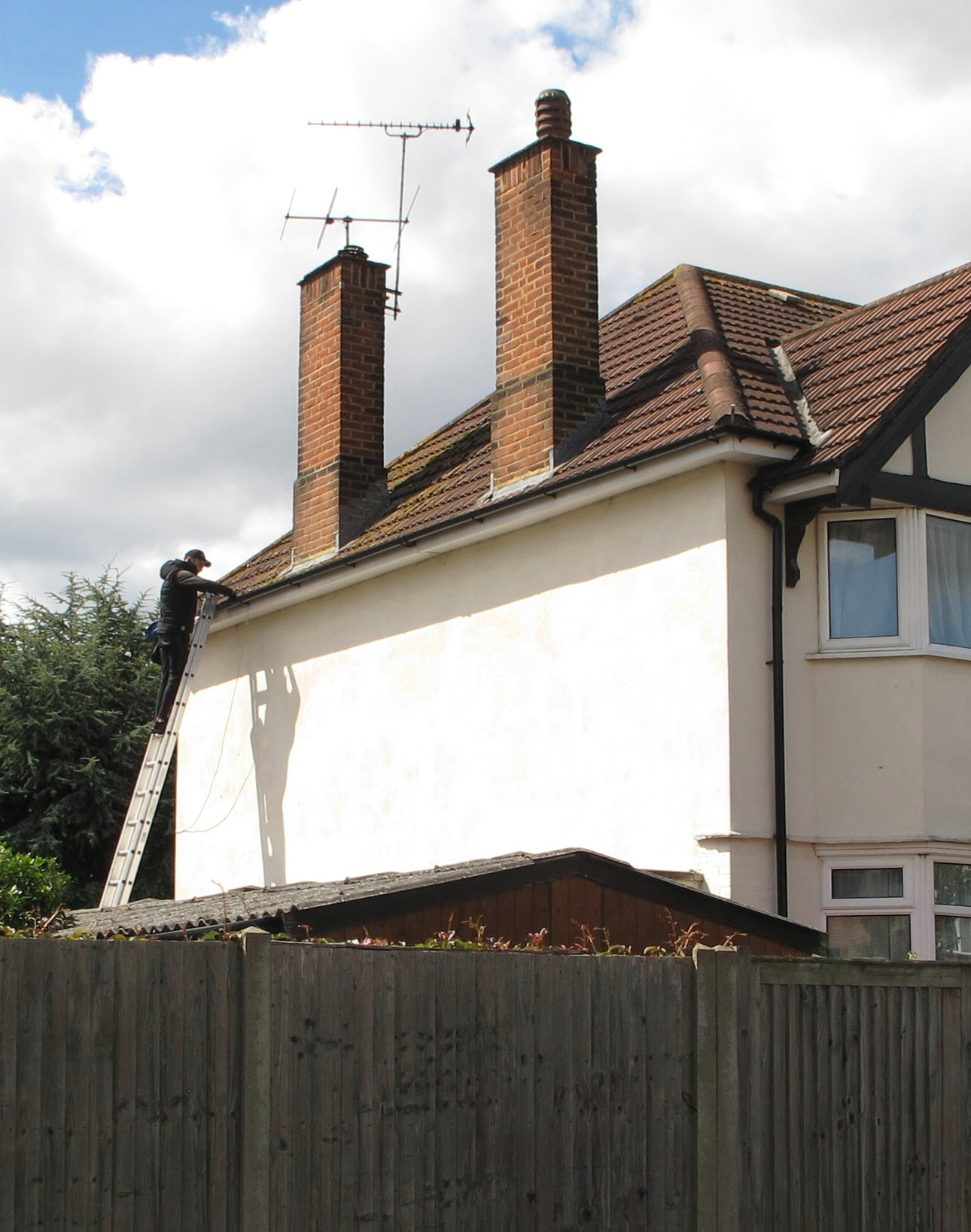
What counts as roofline work?
Before the DIY-versus-pro question makes sense, it helps to define the moving parts. “Roofline” is the plain-language bundle of parts along the edge of the roof: the fascia board at the front edge, the soffit underneath the overhang, the gutter that carries water away, and the downpipe that takes it to ground level.
That sounds tidy, but roofline problems are rarely isolated. A gutter issue can show up as staining below the eaves. A loose fixing can look like a small gap until the next heavy rain makes it obvious. A cracked seal can drip only when the wind pushes water in the wrong direction, which is a very inconvenient kind of surprise.
So the real question is not “Can I touch this?” It is “Can I tell what is happening without creating a bigger risk while I am looking?”
DIY-friendly tasks: the safe, boring, useful work
I would put the following tasks in the DIY column for most homeowners, provided they can be done safely from ground level or another stable, low-risk position.
- Visual checks after bad weather. Look for sagging gutter lines, obvious blockages, and water marks below joints or downpipes.
- Photographing suspicious spots. A few clear photos beat a vague memory every time.
- Removing obvious debris from reachable low points. If leaves have collected at a low, accessible outlet, that is a sensible place to start.
- Checking the same area from inside the house. Stains, damp patches, or repeat drips help narrow the problem down.
- Noting when the issue appears. First rain after a dry spell? Only in heavy rain? After wind? That pattern matters.
For homeowners who want a practical reference point, This Old House has a helpful overview of how to clean gutters and another guide on basic gutter repair. The useful part is not that every step belongs in your toolkit. The useful part is seeing where a routine clean ends and a real repair begins.
There is one rule I would keep in bold in a notebook: if the job starts asking you to work at height, pause. The HSE’s ladder guidance is clear that work should be planned sensibly and proportionately, not treated like a reflex action. That is exactly the right mindset for roofline care too.
Why some jobs should be left to pros
Some roofline jobs look simple because the visible part is simple. The hidden part is where things get expensive.
Three reasons usually push a roofline job into professional territory:
- Access risk. If you need a ladder, roof access, or awkward reaching to do the work properly, the task has already changed category.
- Fixings and support. Loose brackets, tired fixings, and hidden movement often explain the symptom better than the visible dirt does.
- Water sealing. A joint that looks fine from the ground can still fail under pressure when rain, wind, and movement line up in the wrong way.
That last point is why roofline repairs are not just “seal the gap and carry on.” Water is very good at finding the weak part of a system and very unhelpful about announcing its visit ahead of time. A professional assessment is often worth it when the same spot keeps leaking, the gutter sags, or the fascia looks as if it is carrying more weight than it should.
The HSE’s safe use of ladders and stepladders guidance is worth a glance if you are tempted to treat access as a minor detail. It is rarely a minor detail in roofline work. The moment the job depends on being higher than you can comfortably inspect from the ground, it becomes a safety and workmanship question at the same time.
A quick comparison: DIY or pro?
| Situation | Usually reasonable DIY? | Why |
|---|---|---|
| Leaves visible in a low, reachable section of gutter | Yes, if safe from the ground | That is basic maintenance, not repair. |
| Water spills from the same joint after every rain | No | That suggests a seal, slope, or fixing issue. |
| Staining below the fascia or soffit | Usually no | There may be hidden moisture or failed sealing. |
| Loose or bowed gutter run | No | That points to support or bracket problems. |
| A quick visual check after wind | Yes | Observation is cheap; guesswork is not. |
| Replacing boards, seals, or sections up high | No | That usually needs access equipment and proper installation. |
How to decide from the symptoms
A simple rule helps here: one-off debris is a maintenance problem; repeat water behavior is a system problem.
That distinction matters because a lot of homeowners understandably start with the first visible thing they can see. If the gutter is full of leaves, of course that looks like the problem. But if the same section overflows even after a clear-out, the underlying issue is probably something else: a wrong fall, a tired joint, a blocked outlet below the visible run, or a section that is moving out of alignment.
Here is a symptom map I would actually use:
- One spill after a storm: check for obvious debris and note whether it happens again.
- Repeated overflow in the same place: book a professional inspection.
- Visible gap or sag: treat it as a repair, not a cleanup.
- Staining on walls or boards: assume water has been there more than once.
- Damp indoors near the eaves: get it looked at sooner rather than later.
It is tempting to think, “I will just watch it one more time.” Sometimes that is fair. But if the pattern is repeating, waiting usually just buys the water another chance to make the argument for you.
What to document before calling a specialist
If you do need help, the best thing you can do is hand over a clear picture of the problem. A few minutes of documentation often saves a lot of back-and-forth later.
- Where the problem is. Note the side of the house, approximate height, and exact section if you can.
- When it happens. Is it every rain, only heavy rain, or only after wind?
- What you can see. Sagging, staining, drips, gaps, or debris.
- What you already checked. This keeps the conversation efficient and avoids repeating obvious steps.
- Photos from a safe position. Wide shots and close-ups both help.
For contractors, landlords, and property managers, this sort of handoff is easier when the notes, photos, and follow-up questions live in one place. A neutral example is a work order management software builder, which can help keep the job trail tidy when multiple issues need tracking. For homeowners, the same idea still applies: the cleaner the notes, the faster the next conversation usually goes.
If you are not sure what matters most, write the problem in one sentence and add the date of the last rain. That alone can separate “maybe a one-off blockage” from “this has been happening for weeks.”
Common DIY mistakes that make things worse
Most DIY mistakes are not dramatic. They are the boring kind that quietly add risk or hide the real issue.
- Starting with the ladder instead of the symptom. If you cannot inspect it safely from the ground, the job may already be past DIY.
- Sealing over dirt or moisture. That often hides the problem for a bit and then loses the argument.
- Mixing parts without checking compatibility. A neat-looking fix can still fail if the materials do not match properly.
- Cleaning one section and ignoring the rest of the run. The blocked section may be obvious; the cause may not be.
- Using too much force. Gutters and roofline parts are not impressed by enthusiasm.
- Calling the issue “just cosmetic.” Staining and sagging are often clues, not decoration.
The HSE advice to work from the ground where possible is sensible because it reduces the chance of turning a maintenance task into a fall problem. That is a useful habit to keep. Plenty of home jobs become safer and more honest once you stop trying to make every fix from a ladder.
The plain version: what is worth doing yourself?
If I had to compress the whole thing into one practical rule, I would put it like this:
- DIY: look, photograph, note, and handle simple ground-level maintenance.
- Call a pro: anything involving height, repeated leaking, loose parts, or hidden water paths.
That split is not about being timid. It is about being accurate. Roofline work rewards simple observations and punishes guesswork. The good news is that you do not need to solve the whole system to make a good first decision. You only need to know whether the issue is a quick check, a basic clean, or a job that deserves proper access and repair methods.
So the next time you spot a gutter stain or a suspicious drip, start with the cleanest question: Can I safely learn anything useful from the ground? If yes, do that first. If no, stop there and call it what it is.
And if you want help thinking through the next step, the contact page is the easiest place to send a few photos and a short description. If you are just orienting yourself, the home page gives you the broader site overview.